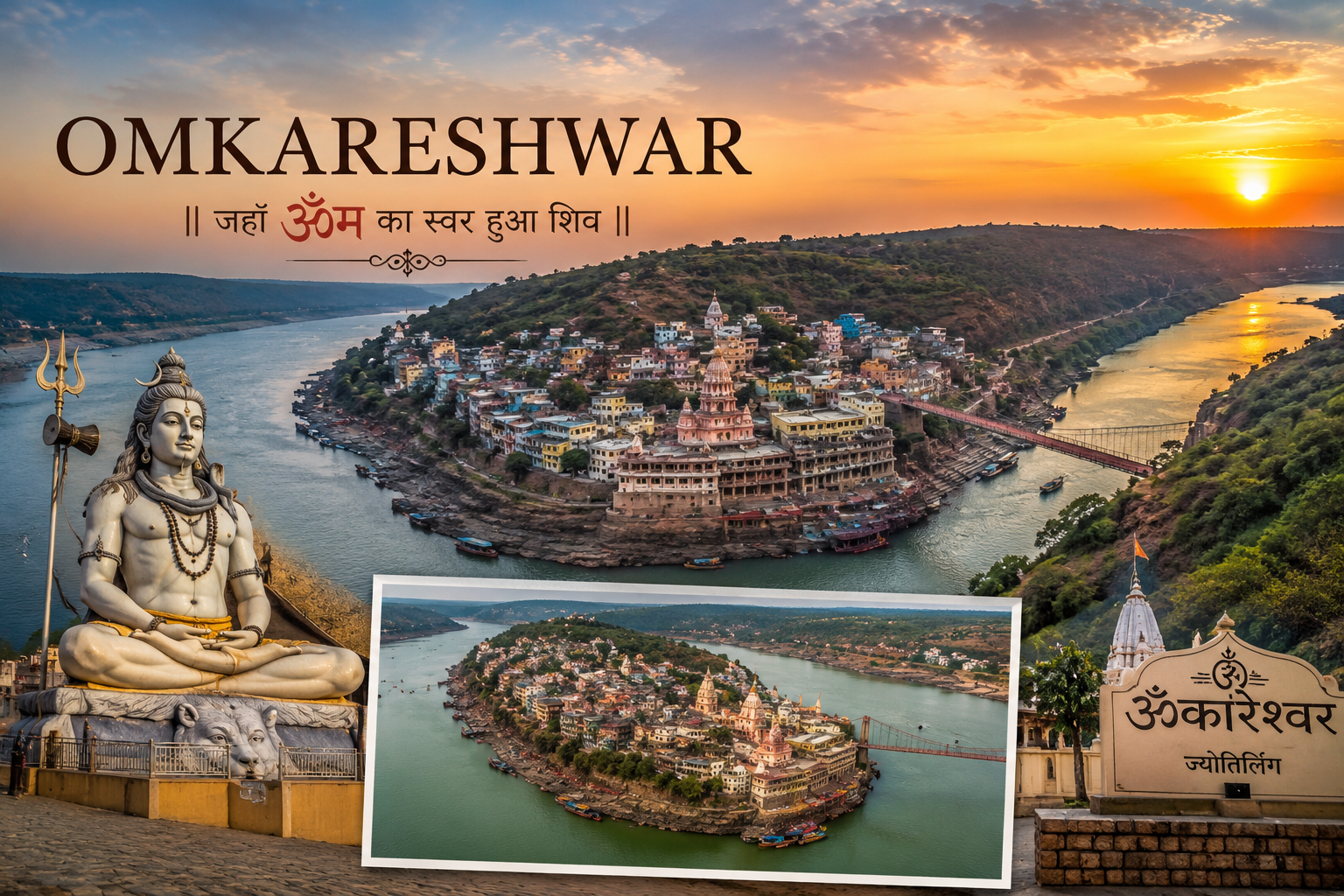
Omkareshwar is truly extraordinary it is not just the ancient temples or the river's sanctity — it is the shape of the land itself. From above, the island of Mandhata traces the sacred syllable ॐ (Om). The earth here did not just attract the divine; it became it.
The Miracle of Shape
Ancient pilgrims noticed something uncanny long before satellite imagery confirmed it: the island of Omkareshwar naturally forms the shape of the Om symbol when seen from above. The Narmada embraces it from both sides, the land curves and juts in precisely the contours of that eternal syllable.
In Hindu cosmology, Om is not merely a word — it is the sound from which all creation unfolded. That the earth itself should sculpt this symbol in a place where one of the twelve Jyotirlingas stands is, for millions of pilgrims, proof that the universe has a signature — and it wrote it here.
Two Temples, Two Shores
Omkareshwar hosts two of the twelve Jyotirlingas, making it perhaps the only town on earth with this distinction.
- The Omkareshwar Temple crowns the Om-shaped island, its five-storied shikhara visible across the wide Narmada.
- The Mamleshwar Temple (Amareshwar) stands on the southern bank as its sacred mirror.
Pilgrims cross the Narmada by wooden boat at dawn, water golden with first light. To touch both temples in one visit is to complete a circuit that devotees believe dissolves karma accumulated over lifetimes.
Adi Shankaracharya & The River Caves
The 8th-century philosopher Adi Shankaracharya — whose Advaita Vedanta reshaped Hindu thought across India — arrived at Omkareshwar as a young seeker. He met his guru Govinda Bhagavatpada in the caves along the Narmada's banks and spent years here in study and deep meditation.
Those caves still exist. You can sit in them. The silence inside is the kind that listens back.
The Parikrama — Walking the Om
The island's most sacred ritual is the parikrama — a 7 km barefoot walk circumambulating Mandhata island, the Narmada always to your right, with 68 shrines along the route.
In walking the Om, pilgrims trace a prayer with their feet. The walk takes about three hours. During Mahashivaratri, thousands walk it shoulder-to-shoulder in the dark, lamps in hand — one of the most moving sights in all of India.